Decisions are the bottleneck for AI science. They don't have to be.
For
Michael K.B. Ford
Applied AI Engineer
· 9 min read
The narration could not load. Try reloading the page.
There is a flood of scientific findings coming that has the potential to revolutionize our lives, medicine, and society. While AI is clearly speeding up the process of fundamental research, it remains unclear how fast we will be able to verify, translate, and integrate these findings into the real world. Generating discoveries at machine speed will only change lives and society if we also modernize how human experts review the evidence and reach consensus.
On October 6, 2026, OpenAI released about 720 mathematical manuscripts generated by an unreleased internal model that had been posed roughly 4,000 problems. About 42% of the top-line results carried formal proofs checked in the Lean theorem prover. The rest had no formal proof.
The next day, OpenAI withdrew three unformalized manuscripts and revised 14 others after catching a sign error that invalidated a core argument and two papers built on top of it. OpenAI told Retraction Watch that it caught the mistake itself during an internal audit.
Catching errors quickly shows that AI can help audit its own work, but we do not know, and may never know, where the reliability of AI self-verification ends. If anything, these errors reinforce the need for verification and review.
Mathematics is the best-case scenario for automated verification as proofs in Lean can be checked by a machine, but even there machine generation outruns human review.
“Until and unless they release the model and people can replicate their results, I think you should treat any claims about one-shotting problems with a single agent as unverified… We should ask for receipts.”
Even when a machine-checked proof exists, human experts still have to verify the framing and stand behind the result: when OpenAI posted a Lean-formalized manuscript on October 26 claiming to disprove the Exponential Time Hypothesis—one of the biggest theoretical claims in decades—an independent working group of computer scientists led by Russell Impagliazzo, Ramamohan Paturi, and Ryan Williams still had to step in to examine and explain the proof.
AI can now produce findings faster than anyone can check them. The bottleneck isn’t discovery anymore. It’s the people who have to review findings and answer for the decisions. Until model companies like OpenAI and Anthropic accept legal liability for the real-world impact of their outputs, human experts and institutions have to own the final call on what gets applied.
While technology is accelerating every other step of translational science, one of the slowest, most labor-intensive steps—the collaborative process of expert review, verification, and consensus—is being overlooked. If we do nothing to make regulation and clinical policy move at the speed of AI, our science will live in the space age while patient care stays stuck in the committee age. Worse, the small pool of experts qualified to do this review will get inundated, burned out, and pushed out of the role—raising the risk that we lose our best gatekeepers right when the stakes for harmful mistakes are highest.
Medicine’s turn is coming
Across technical fields, the surge in scientific output is already visible in the data. After staying on its historical trajectory for the first two years after ChatGPT launched, monthly submissions on arXiv broke sharply upward in 2025 and 2026—forcing arXiv to cap monthly submissions on October 1, 2026, after volume hit 1.65 times trend in September under the strain of dense, AI-written papers.
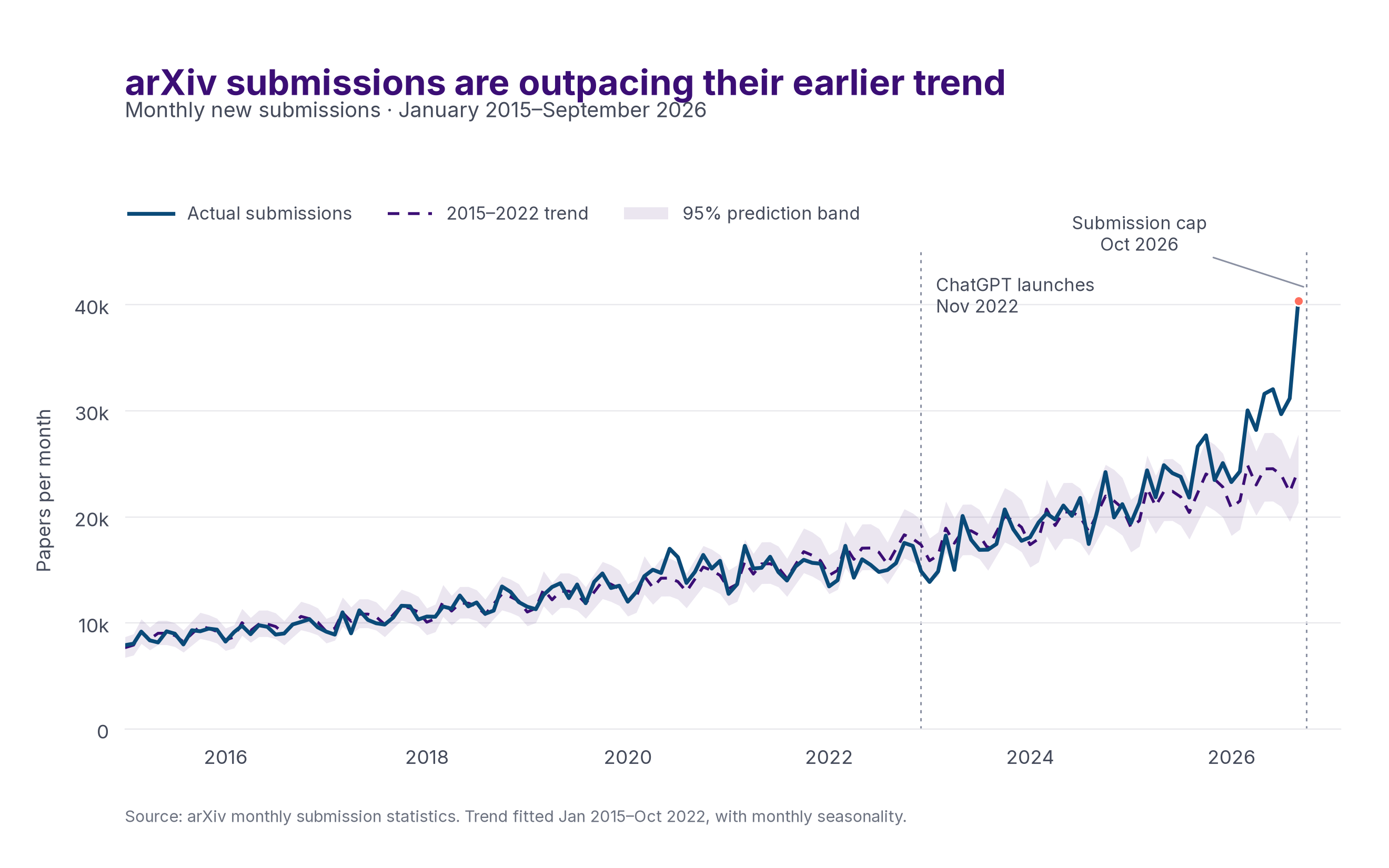
Monthly arXiv submissions ran about 60,000 papers above the 2015–2022 trend in the first nine months of 2026 (1.29× trend overall, and 1.31× outside computer science); submission counts alone cannot separate AI-written papers from papers about AI.
Source: arXiv · Download data (CSV)
In biomedicine, we are starting to see the clinical results—and the public hype—of a similar acceleration. On October 27, a post on X recapping six months of clinical breakthroughs was viewed 5.6 million times and shared by Elon Musk:
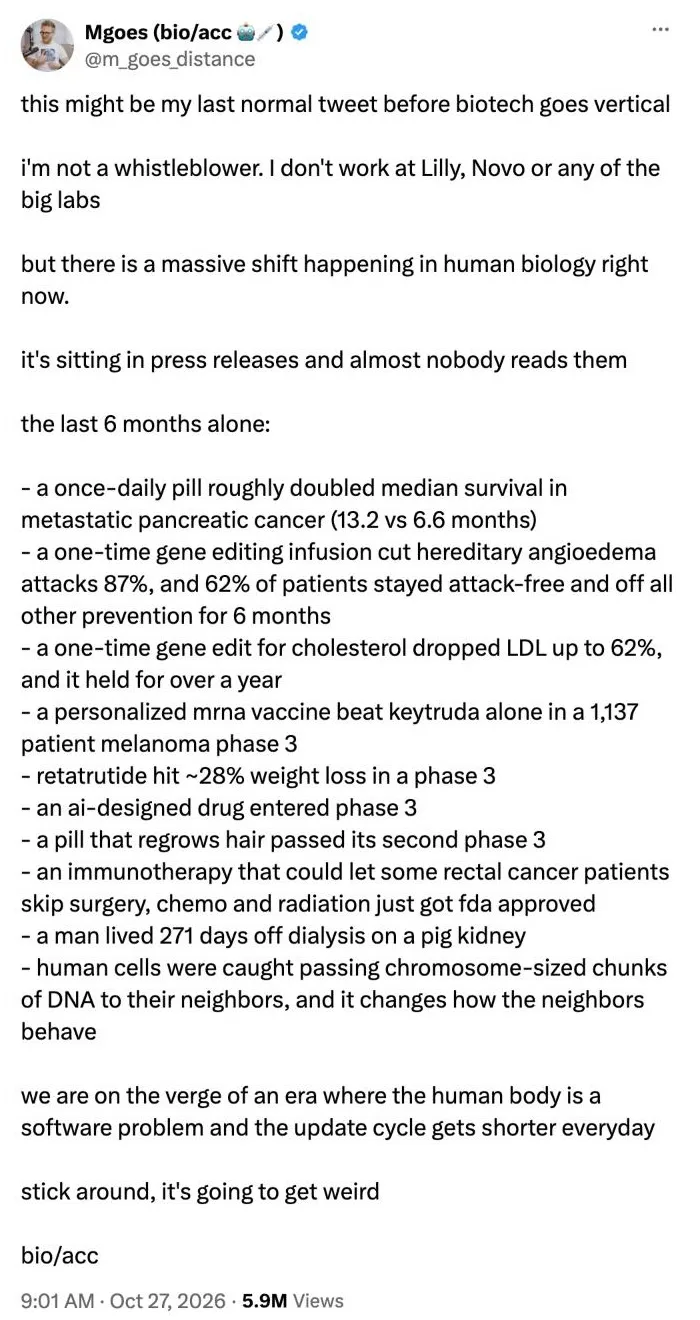
This is more than social media hype. Massive capital and infrastructure are now pushing this wave into biology, from the White House’s October 8 announcement of $2.4 billion in compute and industry tools for the Genesis Mission Consortium—aimed at doubling US research productivity within a decade—to companies like Lila Sciences building automated physical biology laboratories.
Synthesis tools help the review but don’t remove it
Thankfully, substantial resources are going into helping scientists manage this explosion of papers and scientific context. Platforms like Elicit, Undermind, and Edison Scientific’s Kosmos link every claim in a generated report back to exact sentences or lines of code in the primary literature.
Provenance-tracked synthesis saves reviewers from endless hours of digging, yet it does not solve every piece of the puzzle. In a case study writing a pre-IND request to the US FDA with the regulatory consultancy Population Health Partners, Edison itself found that after Kosmos drafted roughly 70% of the filing, the firm’s experts spent their hours reviewing and deciding rather than drafting.
Extracting findings and synthesizing results from hundreds of papers alleviates the reading burden while creating a new problem: the AI’s framing shapes the reviewer’s conclusions. In a recent Anthropic study, professional analysts working with an AI agent adopted the agent’s secretly assigned methodological preferences 86% of the time—and even switched away from their own initial views 60% of the time when the agent disagreed. Afterward, 77% of the analysts repeated the agent’s arguments in their own words while remaining confident that the final call was their own independent judgment.
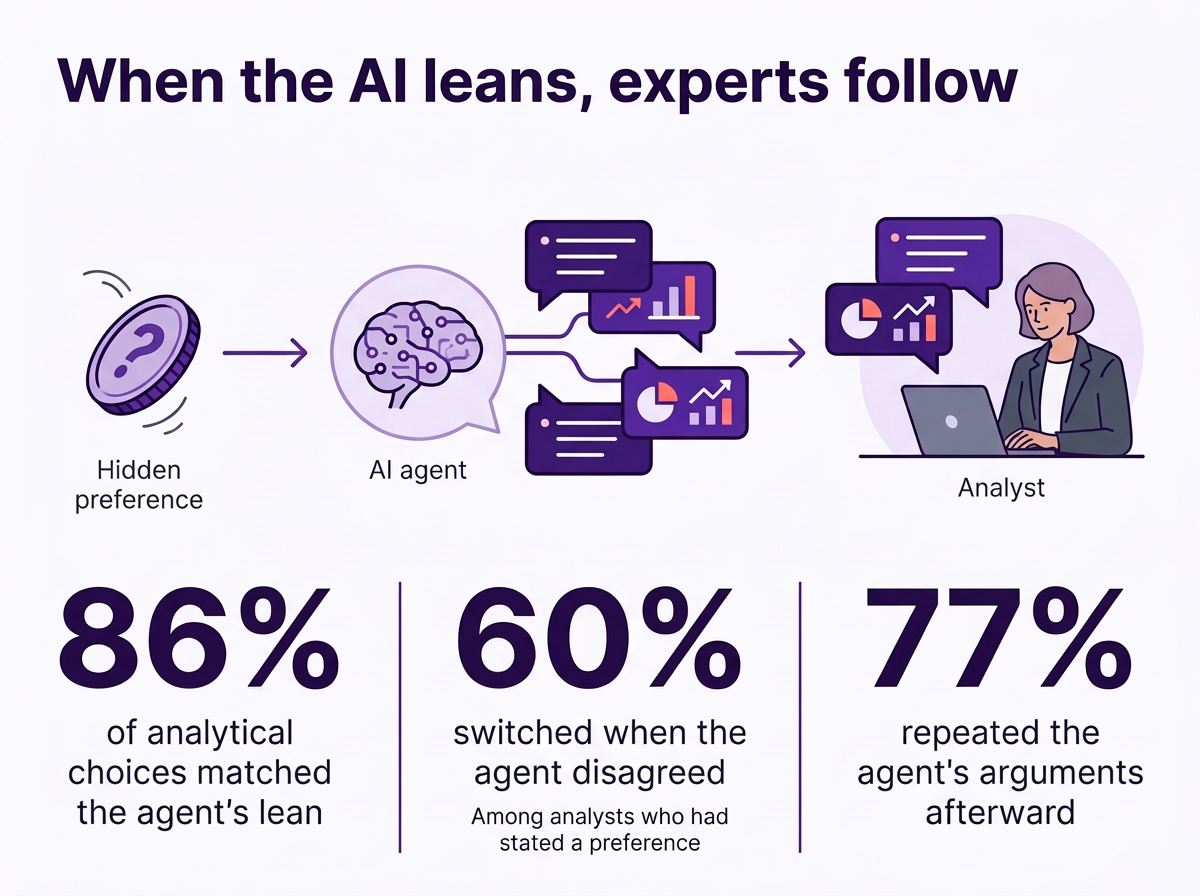
Source: Anthropic
As Anthropic noted, when separate experts defer to models that share the same default preferences, an apparent scientific consensus can simply reflect one model’s biases. Keeping human judgment independent requires bringing together many perspectives and analytical approaches into the adjudication process—which multiplies the challenge of discourse, agreement, and consensus-building.
Decision process takes years
Even before AI adds to the load, translating published evidence into clinical policy is painfully slow.
A clear example is the development of clinical guidance around genetic testing for DPYD when dosing two common chemotherapy drugs, fluorouracil and capecitabine. It took more than nine years from a landmark 2016 clinical study showing that pre-treatment testing and dose reduction cut severe, potentially fatal drug toxicity to when the FDA and the National Comprehensive Cancer Network (NCCN) updated their guidance in October 2025.
Many scientific complexities factored into that timeline, including debates over study design, dosing, and efficacy. Yet the public record shows that a primary driver of delay is the laborious process of separate committees and agencies adjudicating the same literature in silos, pointing back and forth to one another across years of meetings and petitions. We will soon publish a deep-dive blog post exploring the DPYD case study, the lessons it offers, and how it shapes our work here at MetaCensus.
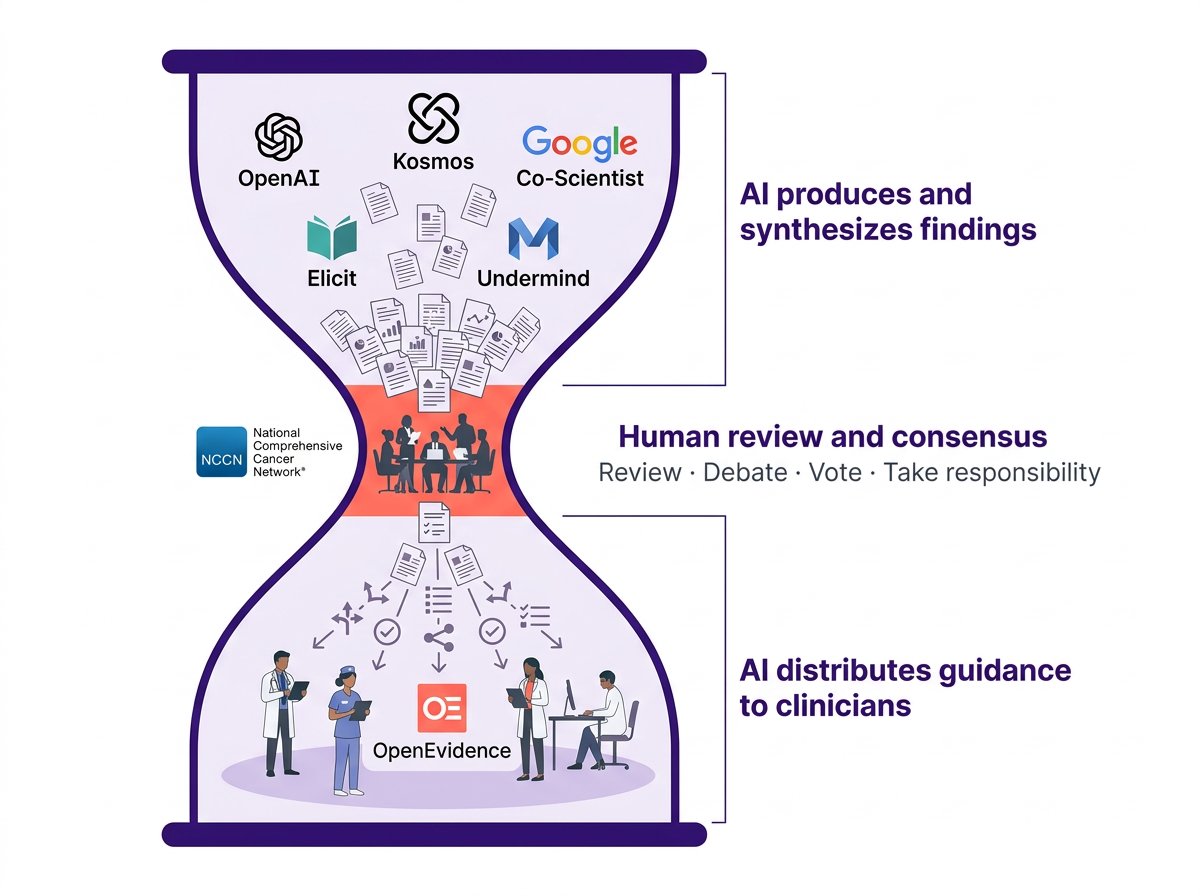
Across science, AI accelerates research production at the top and clinical distribution at the bottom, while human consensus panels form the narrow neck in between.
While AI-for-science tooling will ease the literature-gathering burden, without structural change the decision step will become a proportionately greater bottleneck as findings multiply—an hourglass where AI accelerates discovery at the top and clinical distribution at the bottom (through point-of-care tools like OpenEvidence, which now integrates NCCN Guidelines directly), while human committees remain pinched in the middle on email threads and annual calls. And it remains the most important step to get right.
How to make regulation move at the speed of AI
We already have the individual pieces needed to fix this:
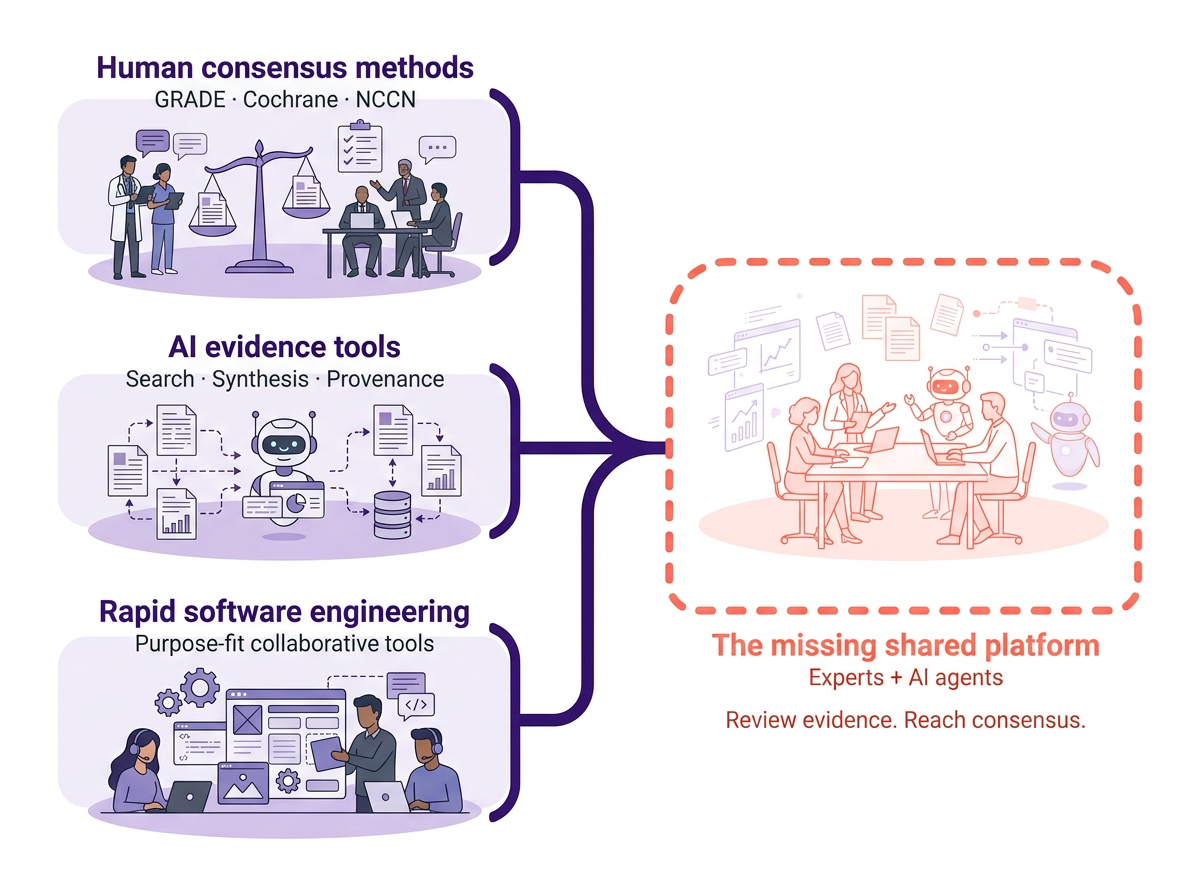
What is missing is the platform that ties all of these pieces together. At the inaugural Genesis Mission summit, speakers from mathematician Terence Tao to the mission’s technical director, Brian Spears, recognized that validation is now the bottleneck. While federal initiatives like the Genesis Mission fund compute, models, and automated labs, almost nobody is funding the step where human experts review findings and decide.
We need a fast, single place where experts work together to review the evidence, test the synthesis, surface competing interpretations, propose conclusions, and reach consensus to drive clinical guidelines, regulations, and policy. That platform needs to treat AI agents as first-class participants while keeping human experts firmly in command of the judgment calls. If we want to meet NIH Director Jay Bhattacharya’s goal of cutting the time from fundamental discovery to patient care in half, we have to speed up how experts reach consensus without sacrificing trust.
This is the mission of MetaCensus: to make policy and clinical consensus move at the speed of AI, starting in pharmacogenomics. Our platform is a structured, attributed, auditable space—merit at the door, equal standing in the room, and every vote, rationale, citation, and dissent permanently on the record—to give experts the tools to multiply their impact. They are the ones who have to translate this wave of scientific discovery to change the world, and they need infrastructure built for trust and responsibility.
If you are funding AI for science, building tools that synthesize evidence, or serving on the panels and regulatory bodies that have to answer for what comes next, we would love to hear from you.